
How Is AI Actually Rebuilding the Construction Industry? 5 Surprising Insights
From generative scheduling to ethical data bias - here's what's really changing on job sites right now, straight from our conversation on TylkoTALK.
AI is no longer a "chatbot novelty" in construction - it's actively rewriting job descriptions and project outcomes. In this article, we break down the five most impactful ways AI is reshaping the AEC (architecture, engineering, construction) industry, based on our conversation on TylkoTALK.
Why does data matter more than steel or concrete in AI-ready construction?
Because fragmented data - not lack of ambition - is the industry's biggest bottleneck to using AI effectively. Project managers live in spreadsheets, architects work in design software, and supply chains run on isolated ERP systems. When these systems don't talk to each other, AI tools are starved of the clean, structured data they need to be useful.
To fix this, the industry is moving toward "Information Architecture" built on a Common Data Environment (CDE) - using standards like ISO 19650 and Industry Foundation Classes (IFC) to keep data interoperable across the entire project lifecycle.
What is generative scheduling, and why does it matter?
Generative scheduling is a shift from static project planning to AI-generated, constantly-updating schedules. Platforms like Alice Technologies or Autodesk Forma work like having a chess grandmaster on-site who can see 10,000 moves ahead.
Instead of a human manually moving blocks on a spreadsheet, these systems use constraint-based logic and Monte Carlo simulations to find the most efficient path through a project. Feed the algorithm real constraints - a crane's swing speed, concrete cure times, crew shift limits - and it maps out thousands of possible realities.
The result: a schedule that behaves like a living organism, reacting to weather, labor shortages, and supply chain shifts in real time - instead of a static document that's outdated the moment it's printed.
Can AI replace veteran superintendents on the job site?
No - and that's the point. Veteran builders are the safeguard against what the industry calls "Naive AI": algorithms that calculate perfect paths with superhuman speed, but remain blind to the messy, physical reality of an actual job site.
An AI might suggest an optimal schedule, but it can't "see" that a dust storm is degrading the lenses on site cameras, breaking the edge detection that computer vision safety systems rely on. A veteran superintendent notices the drop in visual contrast immediately and knows the system will start missing real safety violations. This "human in the loop" oversight is also required by ASCE standards.
Three things a veteran knows that an algorithm doesn't
- How a specific local labor force actually moves on a Tuesday afternoon versus a Friday morning
- The nuanced risks of pouring concrete in freezing rain that generic data might overlook
- How to phase a complex excavation around live, unmapped city utilities that don't appear in the digital twin
How is AI making sustainability a design variable, not an afterthought?
Generative design tools - like Allplan or Autodesk Construction IQ - now integrate energy performance from the earliest concept phase, instead of checking sustainability after the design is already finished.
Google's Bay View campus is a well-known example: generative algorithms assessed countless combinations of roof designs and solar panel layouts to maximize renewable energy production. In Singapore, a housing complex used generative models to orient units and minimize west-facing glass - cutting cooling loads by 19% without increasing construction costs.
What does ethical AI look like in construction?
It means treating unbiased data as a safety requirement, not just a nice-to-have. The ASCE Code of Ethics (updated February 2024) makes this explicit: Section 1H requires engineers to consider the capabilities, limitations, and implications of emerging technologies, while Section 1A requires protecting the health, safety, and welfare of the public.
Failing to de-bias data is a professional failure with real consequences. For example, training a model on geotechnical reports from coastal Tampa and applying it to a project in rocky Denver could lead an AI to suggest soil remediation suited to sand - instead of the slope stability analysis rock actually requires.
Used correctly, though, AI can also be a "vessel for inclusivity" - Section 1G of the same Code encourages addressing diverse social and cultural needs. Natural language processing can explain complex engineering concepts across language and experience gaps, helping a more diverse workforce contribute to high-level decisions.
Conclusion: will data exclusivity become construction's new competitive edge?
The "AI-ready professional" is a hybrid thinker - someone who combines deep construction domain expertise with rigorous data stewardship. You don't need to write Python scripts, but you do need to know how to steer the system, read the dashboard, and recognize exactly when to hit the emergency kill switch.
As AI standardizes the "perfect" build process - optimizing every 4D schedule, eliminating every geometric clash - competition in AEC may shift entirely: not on how well a company pours concrete, but on the depth, quality, and exclusivity of the data it holds.
Frequently asked questions
Generative scheduling uses constraint-based logic and Monte Carlo simulations to generate and continuously update construction timelines. Instead of a static Gantt chart, the schedule reacts in near real time to changes in weather, labor availability, and supply chains.
No. AI can calculate optimal schedules and flag risks fast, but it can't interpret messy, real-world site conditions the way an experienced superintendent can. Industry standards like ASCE's require a "human in the loop" to validate AI-generated decisions.
Because AI tools are only as good as the data they're fed. Fragmented, siloed data across spreadsheets, design software, and ERP systems is the industry's biggest barrier to effective AI adoption - making clean, structured data as foundational as steel or concrete.
In one documented case, a Singapore housing complex used generative design to reorient units and reduce west-facing glass, cutting cooling loads by 19% without increasing construction costs.
The ASCE Code of Ethics (updated February 2024) requires engineers to consider the capabilities and limitations of emerging technologies (Section 1H) and to protect public health, safety, and welfare (Section 1A) - making unbiased AI training data an ethical and safety requirement, not just a technical preference.
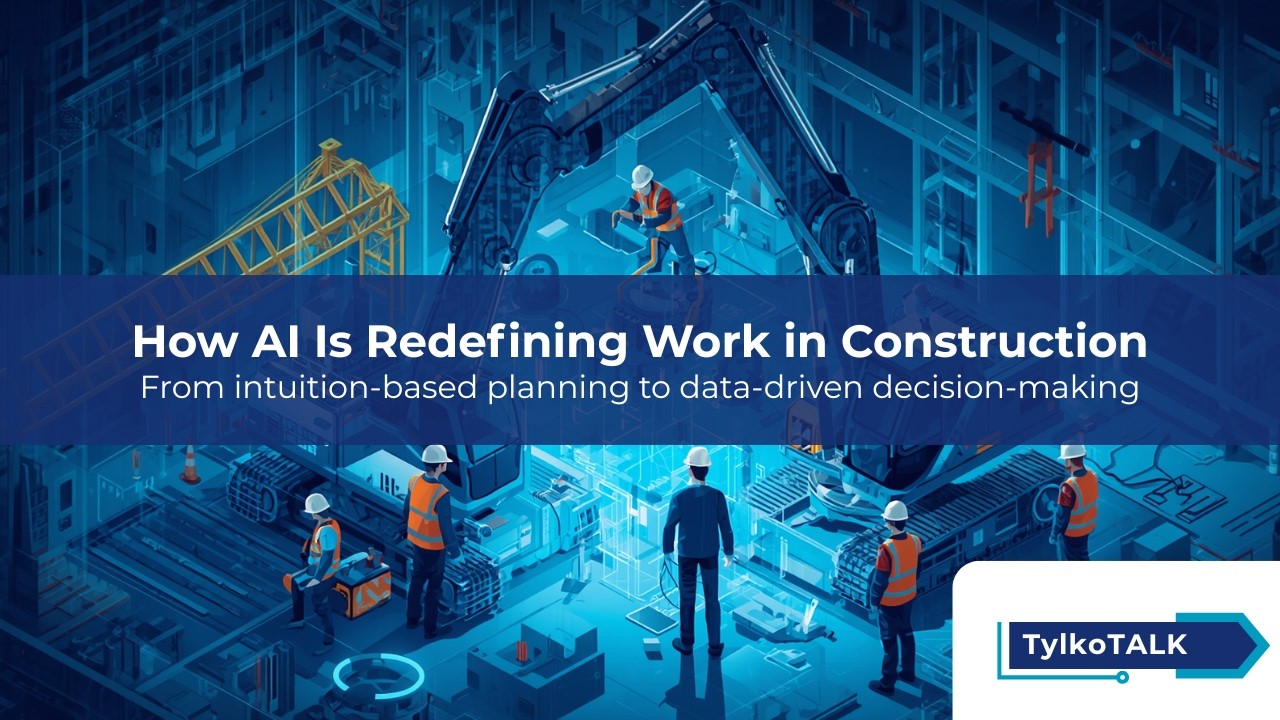
Watch the full TylkoTALK conversation
All five takeaways, explained in depth, straight from the source.
Ready to Master
AI-Driven BIM?
By enrolling in this course, you will learn to:
-
Understand how AI, structured data, and Digital Product Passport requirements are reshaping BIM workflows
-
Apply openBIM standards and IFC to make your project data AI-ready
-
Build practical skills you can use on your next project — not just theory